How it works
How Vesper works
You describe the task. Vesper writes the program and proves it in a twin of your cell. Your engineers approve.
An example from the floor
A packaging line switches from 330 ml to 250 ml bottles tomorrow.
A new board variant arrives on the assembly line on Monday.
- Production engineer
Line 2 switches to the 250 ml bottle tomorrow. Same case pattern.bottle-250ml.step
- Vesper AI
Program rebuilt. 1,400 cycles in the twin, 2 failures, both recovered.
The grip slips on the narrower neck. Moved it to the body and proved it again. Approve?
Approved.
Ready for tomorrow's first shift.
- Process engineer
Board variant B starts Monday. Connector 12 mm further along, longer cable.board-b.step
- Vesper AI
Program rebuilt. 2,000 insertions in the twin, 3 failures, all recovered.
The longer cable catches on the clamp. Rerouted it and proved it again. Approve?
Approved.
Ready for the afternoon shift.
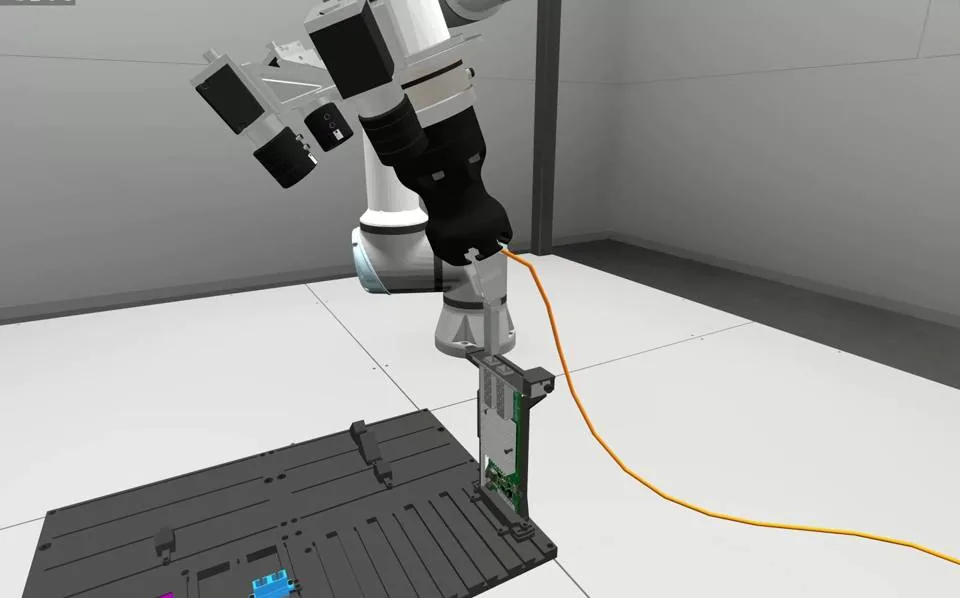
Both examples are illustrative.
Under the hood
Three stages, from brief to running robot.
- 01PlanYou bring the task and the acceptance bar. We scan your cell into a digital twin.
- 02ProveVesper tests candidate programs against thousands of variations and the certified safety envelope.
- 03DeployYour engineers review the program and the evidence, then it runs locally on the cell's industrial PC.
What it lets you do
One approach, four ways it pays off on the floor.
Too much variation for a fixed program.
Programs see the scene, so parts, packaging and placement can vary.
Too few hours to justify its own robot.
One robot moves between stations and serves them all.
Too much change for the integration economics.
A change on the line is a brief, not an integration project.
Too many similar stations to program one by one.
A proven program rolls out to similar stations, adapted and proven again for each.
Hardware
Hardware-agnostic. Any robot, cobot or humanoid.
Your programs carry over when the hardware changes.
Task-built cell
One robot, one task, one layout.
Industrial arm or cobot
Tooling swaps per task.
Mobile manipulator
Shared between stations.
Humanoid
When the next generation lands, Vesper rebuilds every task for it.
Your options