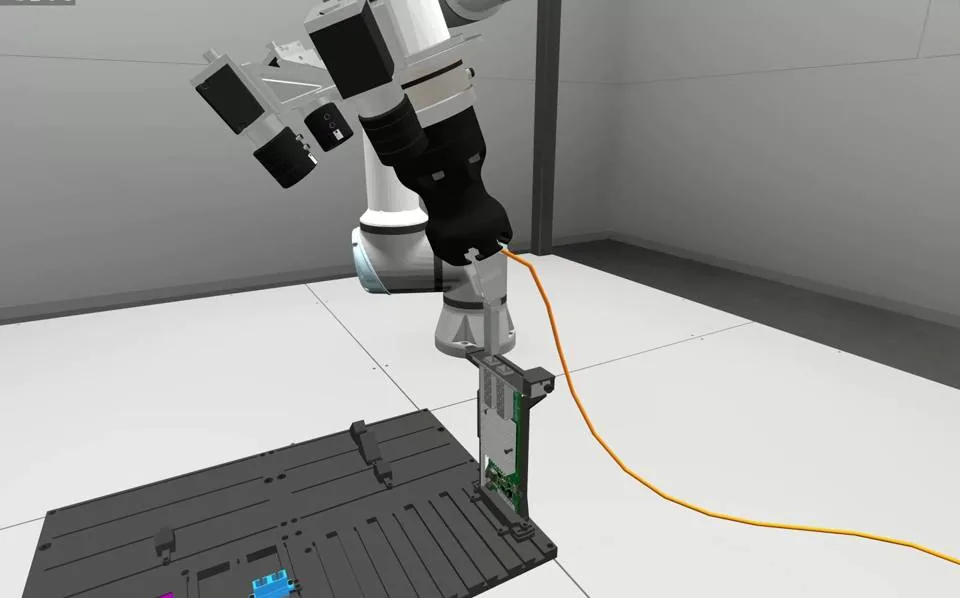
Generative robot programming
Describe the task.
Get a proven robot program.
Vesper turns a task brief into a robot program: generated, proven in a simulation built from your real cell, checked against the certified safety envelope, and run locally on the floor. Every station gets its own program. Every program arrives with evidence.
The result Reliable, certifiable automation of unstructured, high-variation work, at stations classical automation cannot reach.
- Contact-rich manipulation
- Proven on a twin of your cell
- Certified safety envelope
- Deployments in motion: pharma, automotive
Form factors
Vesper works on every form factor. The task decides which one.
A new form factor is modeled in simulation once. Every task is then rebuilt and re-proven for it.
Task-built cell
One robot, one task, bound to its layout. Changed by an integration project.
The automated core of the plant. Not where Vesper plays.
Fixed cobot
One arm, tooling that swaps per task. Every task is a program, written and proven in simulation.
Pick from a container onto the line feed.
Mobile manipulator
The arm on a mobile base. One robot serves the stations that cannot justify a fixed cell.
Serve three conveyors across one shift.
Humanoid
Mass-produced general hardware, improving each generation. Pilot now; when the next generation lands, Vesper rebuilds every task for it.
Pilot on this generation, keep every task.
"Serve conveyor 3 while line 1 is down."
The interface
New task or a change on the line: brief it in plain language.
-
Production engineer
Line 2 switches to the 250 ml bottle on Monday. Same trays. bottle-250ml.step
-
Vesper AI
Pick-and-place program rebuilt. Proven in your line's simulation: 1,400 cycles, 2 failures, both recovered.
-
One catch: the current jaws can't hold cycle time on the smaller cap. I've generated a 3D-printable jaw that can. Design attached. Approve?
-
Approved.
-
Re-proven with the new jaw. STL is on the printer; supervised first runs Monday.
-
Set up once
Your line scanned into simulation, parts catalogued, safety envelope certified.
-
Every task: a brief
Vesper AI writes the program as code and proves it in your line's simulation.
When blocked, it asks, or proposes tooling generated from your part geometry. Every program is code your engineers can read.
≈ Claude Code, for robotics
The problem
Most of a plant is still worked by hand.
A fixed robot only earns its cost back on high-volume lines that never change. Everything else stays manual, for one of three reasons.
Too much variation for a fixed program.
Programs see the scene, so parts, packaging, and placement can vary.
Too few hours to justify its own robot.
One robot moves between stations and serves them all.
Too much change for the integration economics.
A change on the line is a brief, not an integration project.
A program proven at one station rolls out across the hundred similar, but not identical, stations in a plant.
The product
Vesper writes and proves robot programs.
Vesper makes producing a robot program a repeatable industrial process instead of a months-long integration project: generated from your brief, proven in a simulation built from your cell, checked against the certified safety envelope, deployed on the floor.
How it works
Brief in, proven program out
- 01 Plan You bring the task, the environment, and the acceptance bar. Your cell is scanned and rebuilt in simulation.
- 02 Prove Vesper AI generates candidate programs and runs them in the simulation of your cell, against your acceptance criteria, until one passes. Every release is machine-checked against the certified safety envelope.
- 03 Deploy The proven program runs locally on the cell's industrial PC, inside your network.
-
A task is a composition.
Each step gets the method its physics deserves: deterministic control where the world is predictable, learned components where contact forces dominate. Vesper AI composes the full program.
-
Grounded in reality.
Your cell becomes a reconstructed scene and synthetic scenarios, so programs are proven against the cases that break deployments.
-
Certified to change.
The safety envelope is certified once; every new program is machine-checked against it. Re-tasking inside the envelope does not restart certification. Ready for the EU Machinery Regulation of 2027.
Build in the factory, run on the floor: what leaves your plant for training is explicit and controlled.
Why this wins
Classical reliability, learned flexibility.
Classical automation covers the high-volume line that never changes. General-purpose robot models promise everything, eventually. Vesper is built for the work between them. The effect on the floor: stations that were never automatable get automated, and pay for themselves.
The reliability of classical automation, with the task coverage of learned models.
Company
Built by Datameister.
An AI research and deployment lab in Ghent, Belgium. A decade of production AI in vision, 3D, and agents, now pointed at physical AI.
First place in the qualifiers of the Intrinsic AI for Industry Challenge (Alphabet's Intrinsic; jury drawn from Google DeepMind, NVIDIA, Open Robotics, Foxconn, Universal Robots), on dexterous cable insertion.
The canonical contact-rich manipulation task, judged by the people building the field.
More on the lab and its other work: datameister.ai
How we collaborate
Two ways to work with us.
Direct deployments.
For manufacturers. We deliver the running cell ourselves, as the first step of a plan for the lines after it, and hand your team the controls as it matures: operate the cell first, then re-task it, then create new programs on Vesper.
- You
- Bring the task and set the acceptance bar.
- We
- Build and prove the programs, deploy them, and stay responsible under an SLA.
- Partners
- Carry CE marking and the mechanical build where needed.
Partner licenses.
For integrators, machine builders, and robotics platform companies. You deliver programs on Vesper to your own customers, under your own name, for a base license plus a component that scales with robots.
- You
- Own the customer, the hardware, and the IP in the programs you deliver.
- We
- Supply the program generator and the support behind it.
- Split
- Contractual IP split, on-premises, EU-domiciled.
Investors
The vision: the reprogrammable factory.
A factory that assigns work to a fleet of general-purpose robots the way it assigns work to people. Describe the task, and a proven program puts a robot to work. Every program is code, checked against a certified safety envelope, so the flexibility is certifiable: robots re-task without re-certifying.
EU and US seed to Series A. Memo on request.
-
Priced against labour and re-integration cost, which is where the budget already sits.
-
Every delivered program makes the next one cheaper: the learning curve is the margin engine and the moat.
-
Structural EU position: sovereignty, on-prem default, and a credible route to CE-certified re-tasking.
-
The window opened in 2025: simulation, world models, and vision-language-action models matured; the industrial layer that turns them into certified deployments is unclaimed.